Welcome to DReeZone's Website

DReeZone's blog has interesting information on Latest Technology, Mobile phones, Software, Windows, New Gadgets.

The Site shares funny (Comedy) news, pictures and videos.

Also contains tips and tricks on software and mobile phones. (Specially Samsung OMNIA)

The author of the site is a Sri Lankan. All new information on Sri Lanka is also posted in this blog. Sri Lanka is an island situated in the Indian Ocean that has vast tourist attractions. "Sri Lanka a Small Miracle" is the slogan of the Sri Lanka Tourist Board.

Google Wave, First Impression and Review


Posted by Unknown Wednesday, October 21, 2009 0 comments

If you are not among the 100,000 lucky invitees hope you will be able to get a little bit insight from the review.

Those who are willing to get into wave you can request from Google wave and keep your finger crossed.

First Impression

As the first impression the Google wave looks like yet another email program with a navigation pane, massage panel, contacts panel and the message display panel.


When you log into Google wave for the first time, you get bit confused on what to do. But luckily Google has a nice introduction video.

After few tries I found few cool features in Wave.

Real-time Updating tool

In Google wave, you and your colleagues can update documents at the same time. The feature is amazing that you can actually see the text being edited from the other end.

image


Wave editor

All the messages are called ‘waves’. wave editor has all the features needed to edit text successfully. There are several features already in the toolbar

image


Yes/No/Maybe Gadget

image


MSN Maps

image


More Gadgets to come soon.


Invitations

Google tries to increase the demand by limiting the number of invitations. I remember their launch of “GMAIL”. Google only provides 8 invitations to the users. That also only to the account where Google invites.

image


Sadly there are no invitations for those people who are invited by some other Google wave user.  

I am yet to investigate more features and will update all of you accordingly.

Happy (Google) Waving…. :)

Technorati Tags: ,,,,,,,,, ,,,,,,,, ,,,,,,,,

Blogger Labels: Google,Wave,Impression,Review,navigation,pane,panel,contacts,message, introduction,features,Real,tool,colleagues,documents,text,messages, Maybe,Gadget,GMAIL,account,user,Gadgets,Invitations,users,editor

Windows mobile SMS Notification Eraser


Posted by Unknown 0 comments

SMS delivery notification is an annoying thing that Windows
mobile did not get rid of even after their latest version 6.5. You have to
manually delete them all the time…

Here is the solution.

ScreenShot2


This is a simple small program,

  • Erase, so called: delivery report automatically after the selected time.
  • Set the time, when it will erase reports, after the last report
  • Announce the delivery notification with a special sound, at your will
  • Don't need look on screen, and turn the backlight on, because you hear the notification
  • The program runs in Background

DOWNLOAD


YOU HAVE TO make a soft-reset of your mobile device, after installation is finished.

Tested in My Samsung OMNIA under windows mobile 6.5. Works like a charm


Galkissa in MSN Maps..


Posted by Unknown Monday, October 19, 2009 0 comments

Map picture
Technorati Tags: ,

Say NO to Drugs...


Posted by Unknown Friday, October 16, 2009 0 comments

Information about drugs

This section outlines examples of various drugs, their street names, symptoms of use and some of the potential consequences of using them.

People can become addicted to illicit drugs. This can include having trouble controlling their use of drugs and still using them even when they realise it is causing them problems. Drugs can become central to a person’s life and can affect their personal relationships, ability to study and work, mental health and quality of life. People can also become physically dependent on some illicit drugs. This means that they will experience physical symptoms (withdrawal) when they try to stop using them.

People can also develop a tolerance to drugs—this is when a person needs to use more of the drug to get the same effect.


Amphetamine-type stimulants

Amphetamine-type stimulants are synthetic drugs which means they are made by combining various chemical ingredients rather than occurring naturally.

Amphetamines are a family of drugs that include methamphetamine. These drugs are similar in their chemical make-up and affect the messages going to the body’s central nervous system. Currently, methamphetamines are more common in Australia than other amphetamines. These types of drugs are sold in different forms such as powder, paste, liquid, pills and crystals. The potency of these forms varies, with the most potent being the crystalline form, and typically referred to as ice or crystal.

Ecstasy is also an amphetamine-type stimulant because it has a chemical structure that is similar to amphetamines. The effects of ecstasy are different to amphetamines and users may experience effects more typically found in hallucinogenic substances.

Top of page

Amphetamine/methamphetamine

Speed, base and ice are currently the most common street names for these types of drugs. They share the same symptoms and potential consequences but can differ in severity.

Ice

Ice generally looks like colourless crystals or crystalline powder.

The difference between ice, speed and base is the way it is made. The chemicals are the same but ice is a highly potent drug which increases the severity of the potential consequences.

Product: Crystal methamphetamine hydrochloride.

Street name: Ice, meth, crystal, crystal meth, shabu, batu, d-meth, tina, and glass.

Symptoms: In the short term,,ice use can produce increased heart rate, hypertension, irregular body temperature and increase breathing rate. It can also constrict blood vessels and cause heart problems.

Longer-term users of the drug can typically appear older than their age and may have damaged teeth, skin lesions, a greater risk of stroke, decreased lung function and poor cognitive function. There are also studies that have shown the use of ice is associated with brain and mental health conditions, including ruptured blood vessels in the brain, memory loss and psychosis. Other impacts experienced when using ice are social and financial problems, compulsive repetition of actions, family arguments and conflict, the risk of family breakdown and losing friends.

Ice users are at risk of experiencing a drug-induced psychosis, they can become paranoid and hallucinate. A person can also become increasingly aggressive and exhibit violent behaviour possibly requiring chemical and physical restraint or police intervention.

There is a high risk of addiction, including through smoking. Damage can occur to lungs through smoking ice, to the lining of the nose through snorting, and if injected, can lead to scarring, abscesses and vein damage.

Speed and Base

Product: Methamphetamine hydrochloride, amphetamine sulphate (powder, paste, liquid and pills).

Street names: Speed, whiz, go-ee, zip, oxblood, base, paste, pure, gas, meth/amphets.

Symptoms: Euphoria, increased blood pressure and pulse rate, increased and irregular breathing and heartbeat, insomnia, loss of appetite and dilated pupils, confidence, increased energy, talkativeness and excitability.

These drugs can cause anxiety, restlessness, sweating, overheating, blurred vision, nausea and diarrhoea, jaw clenching and/or teeth grinding.

Potential problems: sleep problems, dental problems (e.g., cracked teeth through grinding), weight loss, stroke or heart problems, high risk of dependence. Injecting the drug is also associated with a risk of contracting blood-borne viruses, like Hepatitis C and HIV.

Speed and base can also cause problems with attention and memory, paranoia and paranoid delusions, anxiety, panic attacks, hallucinations, depression, mood swings, aggression, violence, social and financial problems, compulsive repetition of actions, family arguments and conflict, the risk of family breakdown and losing friends.

Top of page

Ecstasy

Product: MDMA (Methylenedioxymethamphetamine), ecstasy.

Street name: Ecstasy, E, Ex, E and C, eccy, MDMA, Adam, XTC, love drug, eggs.

Symptoms: Increased blood pressure and pulse rate, sweating, overheating, jaw clenching, teeth grinding, nausea, anxiety, excitability, tremors, insomnia, enlarged pupils, loss of appetite.

Potential problems: Sleep problems, cracked teeth through grinding, high blood pressure, dehydration, nervousness, hallucinations, memory and attention impairment, decreased emotional control, lethargy, severe depression, possible nerve cell damage, thermal meltdown, death from heart failure.

Top of page

Marijuana (Cannabis)

Product: Marijuana, hashish, Marijuana sativa, delta-9-tetrahydrocannabinol.

Street name: Pot, grass, weed, reefer, joint, Mary-Jane, Acapulco Gold, rope, mull, cone, spliff, dope, skunk, bhang, ganja, hash, chronic.

Symptoms: Difficulty concentrating slow reflexes, impaired motor skills, reduced coordination and concentration, apathy, blood shot or glassy eyes, increased appetite, dryness of the mouth.

Potential problems: Mood swings, memory impairment, weight gain, chronic bronchitis, increased risk of respiratory diseases associated with smoking including cancer, panic attacks, anxiety, depression, paranoid thinking, decreased motivation, interference with reproductive function, learning difficulties, psychological dependence, suicidal thoughts, risk of psychosis and psychotic symptoms. Marijuana serves as a barrier against self-awareness and may interfere with a young person’s development including possible interference with reproductive function.

Top of page

Cocaine and crack cocaine

Product: Cocaine, crack cocaine.

Street name: Cocaine – coke, flake, snow, happy dust, Charlie, gold dust, Cecil, C, freebase, toot, white girl, Scotty, white lady. Crack cocaine – crack, rock, base, sugar block.

Symptoms: Anxiety, agitation, increased pulse rate, large pupils, paranoia, agitation, hallucinations, excitability, euphoria, talkativeness.

Potential problems: High risk of addiction, erratic behaviour, hallucinations, cocaine psychosis, eating or sleeping disorders, impaired sexual performance, ongoing respiratory problems, ulceration of the mucous membrane of the nose, collapse of the nasal septum, cardiac arrest and convulsions.

Top of page

Depressants

Product: Sleeping pills, minor tranquillisers.

Street name: Benzos, temazzies, Valium, tranks, sleepers, Serapax, serries, Mandrax, mandies.

Symptoms: Drowsiness, confusion, uncoordination, slurred speech, depressed pulse rate, shallow breathing.

Potential problems: Anxiety, depression, restlessness, tremors, insomnia, changes in eyesight, high risk of addiction and suicide.

Top of page

GHB

Product: Gamma-hydroxybutyrate (GHB).

Street name: Fantasy, grievous bodily harm (GBH), liquid ecstasy, liquid E, G.

Symptoms: Drowsiness, induced sleep, nausea, reduced inhibitions, dizziness, headache, increased sociability, initial euphoria leading to confusion and agitation.

Potential problems: Extreme drowsiness, loss of consciousness, hallucinations, difficulty focussing eyes, vomiting, impaired movement and speech, reduces muscle tone, disorientation, convulsions/seizures, coma, respiratory distress, slowed heart rate, lowered blood pressure, amnesia and death. Can be addictive with prolonged use.

Top of page

Ketamine

Product: ketamine hydrochloride.

Street name: Green, K, super K, special K, Vitamin K.

Symptoms: Altered perception, disorientation, drowsiness, hallucinations, numbness, strange muscle movements, nausea, vomiting,

Potential problems: Accidents from lack of coordination, quick development of tolerance, psychological dependence, psychosis, flashbacks, loss of memory, attention and vision impairment,

As ketamine is an anaesthetic, when used with depressant drugs such as alcohol, heroin or tranquilizers, it can be particularly harmful as it has the potential to shut the body down causing vital organs such as the lungs or heart to stop functioning.

Top of page

Hallucinogens

Product: LSD (lysergic acid diethylamide), Psilocybin.

Street name: LSD – acid, trips, wedges, windowpane, blotter, microdot. Psilocybin – mushies, blue meanies, magic mushrooms, gold tops, datura, angel’s trumpet.

Symptoms: trance-like state, excitation, euphoria, increased pulse rate, insomnia, hallucinations, paranoia.

Potential problems: visual hallucinations may produce anxiety and fear, confusion and lack of coordination can result in greater risk of injury, self-inflicted injury, violent behaviour, paranoia, depression, anxiety and unpredictable flashbacks.

Top of page

Inhalants

Product: Can include a number of general household and office products – solvents, aerosols, glue, petrol.

Street name: Nitrous oxide – laughing gas, whippits, nitrous. Amyl nitrate – snappers, poppers, pearlers, rushamines. Butyl nitrate – locker room, bolt, bullet, rush, climax, red gold.

Symptoms: Slurred speech, impaired coordination, nausea, vomiting, slowed breathing, euphoria.

Potential problems: Brain damage, paralysis, pains in the chest, muscles, joints, heart trouble, severe depression, fatigue, loss of appetite, bronchial spasm, sores on nose or mouth, nosebleeds, diarrhoea, bizarre or reckless behaviour, suffocation and sudden death.

Top of page

Opioids

Product: Heroin, morphine, codeine, methadone, buprenorphine, pethidine, Dilaudid, Kapanol, MS Contin.

Street name: Heroin – horse, hammer, H, dope, smack, junk, gear, boy. Morphine – M, Miss Emma, Mister Blue, morph. Methadone – done. Buprenorphine – Bupe.

Symptoms: Lethargy, drowsiness, nausea, constipation, constricted pupils, slowed breathing.

Potential problems: High risk of addiction, mood swings, depression, anxiety, chronic constipation, infection at site of injection, HIV and hepatitis infections through sharing of needles, non-fatal overdose and death from overdose.

Technorati Tags:
, , , , , , , ,

Microsoft's office of the future features interactive walls and Surface but, sadly, no Clippy


Posted by Unknown Thursday, October 8, 2009 0 comments


Microsoft shows off prototype next-generation office wall

Technorati Tags: , , , , , , , ,

SL force - Nice 3D Animation work by a Sri Lankan


Posted by Unknown Wednesday, October 7, 2009 0 comments


Modeled, Designed, animated, rendered, sound and video edited by Pubudu Abeywardana Dahanayaka, +9471- 6458992, +09471- 5167686 pubudu.dahanayaka@gmail.comTechnorati

Tags: ,

Mehi Pan Kala Nothabanna.....


Posted by Unknown Saturday, September 5, 2009 1 comments

Me
Posted by Picasa

How to map Samsung omnia wired headset to MS voice dial


Posted by Unknown Monday, August 17, 2009 0 comments

  1. Install MS Voice 1.6
  2. Go to "Settings" -> "Personal" -> "Buttons" on the phone menu
  3. Assign the "Main Menu" (Any hardware button you want) to Voice Command
  4. Install AE Button Plus. Download
  5. Run the Program
  6. Scroll down and select "Green Phone Button"
  7. tap and hold the "Green Phone Button"
  8. Set to "Handle by AEBPlus"
  9. Select the below configuration - Single Press:  "Press Green Button"                                                   Double press: "Main Menu"
  10. Now save the configuration and exit the program. 
Plug-in the wired headset adn press the button and enjoy the voice commands.

ENJOY... :)

Technorati Tags: , , , , , , , ,

How Sri Lanka Missed the Moon


Posted by Unknown Monday, July 20, 2009 0 comments

When  Apollo 11 astronauts landed on the Moon 40 years ago this month, they were more than just Americans taking that historic first step on to another celestial body.


They did plant the American flag there, acknowledging the nation whose tax payers had financed the massive operation. To allay any fears that one nation was claiming the Moon — which was explicitly ruled out by the  Outer Space Treaty of 1967 — they also left a plaque which read: “Here men from the Planet Earth first set foot upon the Moon, July 1969 A.D. We came in peace for all mankind.” It was signed by the three astronauts –- Neil Armstrong, Edwin (Buzz) Aldrin, Jr., and Michael Collins –- and President Richard Nixon.

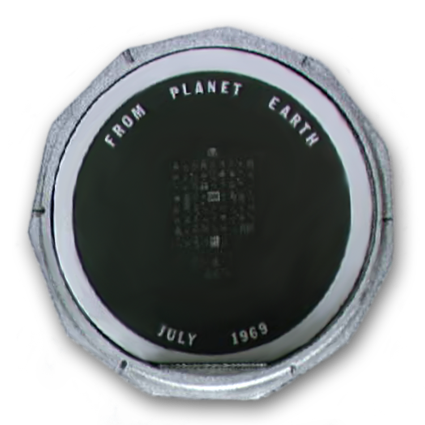
The plaque received wide publicity at the time, but the astronauts actually left behind some more items. Amidst the various scientific instruments and other items gathering dust at the first landing site — in the southern Sea of Tranquility — is a small white cloth pouch. It contains a silicon disc, which is one of the most important and symbolic items taken to the Moon.


Etched on to that disc, about the size of a half US dollar coin, are miniaturised messages of goodwill and peace from 73 heads of state or government around the world. These letters were received by the US space agency NASA only during the final weeks running up to the launch on 16 July 1969, yet this disc helped turn the Apollo 11 mission into an international endeavour.

The disc was a late-breaking idea. It was only in June 1969 that the US State Department authorised NASA to solicit messages of goodwill from world leaders to be flown and left on the Moon. In those days before fax, email and Internet, this triggered a minor diplomatic frenzy. Hurried invitations went out from Thomas O Paine, the NASA Administrator who was ultimately responsible for the lunar missions.

In all, 116 countries were contacted through their embassies in Washington DC, but only 72 responded in time (The United Nations had 127 member states by that time.) With the initiator US, it made up 73 nations. The disc carried statements by US presidents Eisenhower, Kennedy, Johnson and Nixon, each of who had provided political leadership to the American space programme.

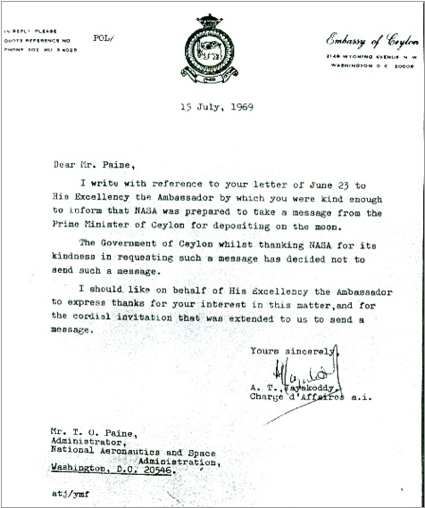
Some countries were confused by NASA’s unusual request. Others asked for more details — without realizing that the window for their inclusion was closing fast. Sri Lanka, then Ceylon, was among those countries that did respond. But for unknown and unexplained reasons, Prime Minister  Dudley Senanayake declined to send a message to the Moon.


In a letter dated 15 July 1969 addressed to the NASA Administrator, A T Jayakoddy, Charge d’Affairs at the Embassy of Ceylon in Washington, wrote:

“The Government of Ceylon whilst thanking NASA for its kindness in requesting such a message has decided not to send such a message.”

The reply, cushioned in diplomatic niceties, gives no hint or reason for the decision. Ceylon thus ruled itself out from being part of the historic mission to the Moon.

Was it some misplaced geopolitical considerations, or simple diplomatic arrogance that led to Ceylon’s negative decision? Why did the Cambridge-educated, liberally inclined Prime Minister turn down the historic opportunity? After all these years, we might never know.

The Ceylonese government’s letter of decline is now part of the public record, thanks to a book that came out in 2007. Titled “We Came In Peace For All Mankind: The Untold Story Of The Apollo 11 Silicon Disc”, it was researched and authored by Tahir Rahman, a Kansas-based physician and space historian.

Last minute rush

The book documents the full story behind this little known facet of the very widely covered Apollo 11 mission. It also reproduces each of the 73 goodwill messages, as well as those which were received too late for inclusion on the disc.

“I was amazed at how NASA and the State Department rushed to get these messages before launch,” says Rahman. He took two months to locate from the Library of Congress the boxes in which Administrator Paine had preserved the full correspondence.

When I contacted him recently for additional insights, Rahman replied: “I do not have any information about why Sri Lanka did not send an Apollo 11 goodwill message.”

Sir Arthur C Clarke, with whom I worked for over 20 years, was also intrigued by Ceylon’s decision, which he didn’t know about until Rahman’s book reprinted the official letter. His only remark: “Mysterious are the ways governments think and work.”

 The Apollo Program, initiated by President John F Kennedy in 1961, was mandated to land a man on the moon before that decade ended. It was one of the largest and most expensive technological undertakings in history, which eventually saw 12 American astronauts walk on the Moon in six successful missions between 1969 and 1972. (One mission,  Apollo 13, was aborted due to an accident but the astronauts returned to Earth.)

The engineering and biomedical preparations for the first Moon landing had been meticulously planned for years. Yet the silicon disc idea had to move from idea to launch in just about a month. That didn’t allow much notice for world leaders to respond.

But the few dozen who did congratulated the United States and its astronauts for making history, and expressed hope for peace to all nations of the world. Some handwrote their messages while others typed. Many were in local languages. A few included intricate artwork, such as the Vatican’s message by Pope Paul VI.

Among those who sent messages were a number of Asian countries including Japan, Malaysia, the Philippines and Korea. Ceylon’s South Asian neighbours Afghanistan, India, Maldives and Pakistan also joined.

“I fervently hope that this event will usher in an era of peaceful endeavor for all mankind” wrote Indira Gandhi, Prime Minister of India.

M Yahya Khan, President of Pakistan, said: “Greetings and felicitations from Pakistan to the American Astronauts who blazed a new trail for mankind by landing on the Moon.”

The Cold War politics are evident in how governments responded, or chose not to. For example, China’s message came from Chiang Kai-Shek, President of Taiwan –- the only Chinese government recognised by the US at the time. Similarly, the Vietnamese message was issued by the president of South Vietnam, whose regime fell in 1975. The Soviet Union and most of the eastern bloc countries were notably absent. However, Nicolae Ceauşescu of Romania sent a one-liner.

Many members of the then fledgling  Non-Aligned Movement (NAM) also took part. Josip Broz Tito, President of Yugoslavia and a founder of NAM, sent an enthusiastic message.

Some countries were initially cautious or uncertain. King Bhumibol Adulyadej of Thailand said in a telegram: “In view of our total ignorance of this project, would appreciate any information you can provide concerning NASA’s invitation to send message… number of countries responding… methods of recording and method of deposit on the Moon.” In the end, the Thai government sent a message just in time.

The king of Thailand is only one of two heads of state still holding office; the other is Queen Elizabeth II. Reading the messages, whose English translations are available online, is like entering a time capsule. Some countries have since changed names. Others have been subsumed by neighbours, or broken into two or more independent states. Geopolitical map of the world has been completely redrawn.

Almost forgotten

Even as the invitations went out, NASA was still trying to figure out how best to archive the messages to withstand harsh conditions on the Moon. Miniaturisation was essential as weight was at a high premium on the spacecraft.

One of NASA’s regular suppliers, the Sprague Electric Company of North Adams, Massachusetts, devised a new technique to inscribe the microscopic messages on the 1.5 inch, 99%-pure silicon disc. Silicon was chosen because it can withstand the extreme temperatures on the Moon.

The same technology is now widely used to make integrated circuits in modern electronics including computers. New at the time, it enabled each letter to be reduced 200 times to a size much smaller than the head of a pin.

The letters, no larger than one-fourth the width of a human hair, could be read under a microscope without any other playback facility. The only text readable by the naked eye is the wording on the rim: “From Planet Earth” and “July 1969″.

Sprague successfully delivered it one week prior to departure, but NASA then wanted to include late arriving messages. The final disc was ready only five days before Apollo 11 lifted off.
Having carried it to the Moon, the astronauts almost forgot to leave the disc behind. In his book, Rahman describes what happened.

Armstrong and Aldrin had only two and a half hours in which to explore the landing site, collect moon rocks and set up some scientific instruments. They also had to take part in some commemorative activities, including erecting the American flag and reading the inscription from the plaque. When President Nixon made an unscheduled call, it further crowded their schedule.

They were about to leave the Moon when Armstrong suddenly remembered the little “package” that was taped on to the arm of his colleague’s spacesuit. Aldrin, already up on the ladder, tossed it down to the ground. Armstrong nudged it with his foot –- there was no time for photographing or filming the moment. They had bigger things to worry about: if the lunar module failed to take off, they would be marooned on the Moon.

“The [transcript] shows that the astronauts almost forgot to leave it on the Moon. Buzz Aldrin confirmed that when I interviewed him,” says Rahman. “The mission was designed for safety first, so I can’t say more attention should have been paid to it. I am just glad it got there!”

After the astronauts returned safely to the Earth to a heroes’ welcome, the silicon disc was quickly forgotten. It earned only an occasional footnote in detailed histories of the Apollo missions. With his detailed account, Rahman has finally filled in the missing story.

Rahman feels that the messages are even more relevant today than they were when hurriedly written 40 summers ago. “The Apollo 11 plaque which states ‘We Came in Peace for all Mankind’ is one of the most important documents in world history — so are those goodwill messages.”


Best picture from Wanni Battlefront, Sri Lanka


Posted by Unknown Monday, June 22, 2009 0 comments

The picture in the attachment was taken on the Final Days at the battlefield in Mullaitivu, Northern Province of  SRI  LANKA  when the so called "Invincible " terrorists named as LTTE or Liberation Tigers of Tamil Eelam,  were  completely decimated by the Sri Lanka Armed services. The long drawn out war of 30 years is over and PEACE has dawned in Sri Lanka  once  again.

The picture epitomises the gruesome atmosphere of a  fierce  battle,  and  the  natural  humanitarian action of a Sri Lanka Army soldier saving a Tamil toddler and taking him to safety.The toddler shows full confidence in the soldier. This picture can be compared  to the award winning  picture  of the  small  girl crying and running naked when a napalm bomb   was exploded by US Army against civilians in Vietnam , which was splashed all over the cover of TIME magazine  and  in  all world  newspapers.


Related Posts with Thumbnails