


Videos courtesy of www.islandcricket.lk

මාධ්ය වාරණයේ නිරුවත
මාපා තිලකසූරිය
පාරේ තිබූ මළ සිරුරක් ගැන කරුණු සෙවීමට ගිය "දිවයින" පත්රයේ මාපලගම මාධ්යවේදී ගුණපාල කාරියවසම් මහතා අප්රසන්න අත්දැකීමකට මුහුණ පා තිබේ.
ගුණපාල මහතා මළ සිරුර ගැන පොලිසියෙන් විමසූ විට ඔවුන් පවසා ඇත්තේ ඒ පිළිබඳව තොරතුරු පොලිස් මාධ්ය ප්රකාශකගෙන් විමසන ලෙසයි. ඒ සඳහා ඔහුට ලබාදුන් දුරකථන අංකය අංක එකොළහකින් සමන්විත බවද ඔහු පවසයි.
ප්රාදේශීය මාධ්යවේදියකු පොලිස් මාධ්ය ප්රකාශකගෙන් එවැනි තොරතුරක් විමසුවේ නම් ඔහුට නිසි පිළිතුරක් නොලැබීමට ඉඩ තිබේ. "අර අංකයට කතා කරන්න" මේ අංකයට කතා කරන්න" සීට් එකේ නැහැ" ආදී දහසකුත් පිළිතුරුය.
ප්රාදේශීය මාධ්යවේදීන් පමණක් නොව වෘත්තීය පත්ර කලාවේදීන් ද සිය වෘත්තිය කරගෙන යැමේදී ඔවුන්ට බලපානු ලබන ප්රබල ගැටලුවකි තොරතුරු දැන ගැනීමට තිබෙන අපහසු බව. තොරතුරු සොයා යැමට ගොස් අපහසුතාවට පත්වූ ප්රථම සහ අවසාන මාධ්යවේදියා "දිවයින" මාධ්යවේදියා නොවේ.
කල් ඉකුත් වූ ප්ලස්මා පෙරණ කට්ටල භාවිතා කරනු ලබන බවට මුලින්ම හෙළිදරව් කරනු ලැබුවේ සිරස" රූපවාහිනිය මගිනි. එහෙත් ඔවුන් ජනතාව වෙනුවෙන් එම තොරතුරු විකාශනය කරණු ලැබුවේ දැඩි අසීරුතා මැද්දේය.
ලක්ෂ ගණනක ලේ පරිත්යාග ශීලී ජීවිත අවදානමකට ලක් කොට කල් ඉකුත් වූ ප්ලස්මා පෙරණ කට්ටල භාවිතා කිරීම ප්රශ්නයක් නැත. එම තොරතුරු හෙළි කිරීම වැරදිය. තොරතුරු හෙළිදරව් කිරීමට මූලික වූ සේවකයන් පසු පස හඹා ගොස් පළිගැනීම නම් සිදු කරනු බව පෙනේ.


Question : 1.
Answer:
- A driver of the Motor Vehicle shall immediately stop the Vehicle
- Furnish his Name and Address, the name and address of the owner of the vehicle the distinctive number of the vehicle and other particulars relating thereto.
- In any case where the person to whom injury has been caused so request, or if he is unconscious or if the injury caused that person appears to endanger life, take that person immediately to near by hospital or to a medical practitioner and thereafter report the accident forthwith to the officer-In-Charge of the nearest Police Station.
- The driver of the vehicle shall forthwith inform the Police Officer and the Gramasevaka Niladhari along with the documents possessed by the driver.
- The driver shall report the accident forthwith to the nearest Police Station or if the driver fails to do so one of the occupants should inform the nearest Police Station within twenty four hours of the accident.
- The driver of the vehicle shall as soon as possible within twenty four hours of the occurrence of the accident shall produce all certificates for purpose of inspection at the nearest Police Station.
Question : 2.
Answer:
You should proceed to the nearest Police Station and lodge a complaint. In the complaint you should mention the number of the driving licence, NIC Number in order to obtain the same having done so obtain the copy of the complaint. In order to obtain a new driving licence produce two copies of your photograph. Also obtain a application forms from the Commissioner of the Motor Traffic Department or from the Katchcheri having perfected the necessary form submit the same with necessary monetary charges to the RMV obtain a copy of your complaint. A copy of your complaint is not a valid driving licence.
Question : 3.
Answer:
- For the purpose of learning to drive a Motor Vehicle a person who has attained eighteen years may notwithstanding that he not the holder of the driving licence, drive on a highway any motor vehicle, other than a motor coach, hiring car or a lorry carrying passengers or goods.
- If you are competent to drive you can teach your son/daughter provided a L shape board is fixed to the front/rear of the vehicle. You should also obtain a learner Insurance policy. The learner should be over eighteen years of age for the trainer to obtain a learner Insurance Policy.
Question : 4.
Answer:
There are two ways
- Having provided a medical certificates and Police reports to relevant Insurance Agencies
- Action has to be instituted in District Court within two years from the occurrence of the accident
Question : 5.
Answer:
Instead of the driving license obtainable for heavy vehicle, categories for light vehicles such as “ C ” & “ D ” licenses could be obtained from the Commissioner of the Motor Vehicle having perfected the relevant form
Question : 6.
Answer:
If there is a traffic congestion after an a accident, you shall immediately mark the road about the position of the tyres of the vehicles, and point of accident and remove it to a side till the arrival of the Police
Question: 7.
Answer:
You cannot obtain spot fine for the above offence. Any person who has contravened this offence shall on completion after summary trial before a Magistrate be liable to a fine not exceeding five hundreds Rupees or to imprisonment of either description for a term not exceeding six Months or both such fine and imprisonment. If you are found guilty your liable to be prosecuted in Courts.
Question: 8.
Answer:
Either you can call over at the relevant Police Station to obtain the next date or motion be submitted to the Magistrate Courts where Traffic cases are taken up and conclude the case. You must also find out the order from the Police Station whether you were re-summoned or warrant issued. The best way of sorting out of a similar problem is to retain attorney-at -law in order to file motion. Remember to honour the Court date.
Question : 9.
Answer:
Traffic Administration & Road Safety are primary functions handle by the Traffic Headquarter Division. This is being controlled and administered by Director Traffic. Requirement of Traffic Demonstration and Lectures could be organizing though the respective Police Station where the OIC of the Police Station has to make an application to Director Traffic Headquarters through their Divisional Senior Superintendent of Police. If more details are require the Director Traffic Police Headquarter could be contacted on Telephone Number 2324984 or OIC Traffic Police Headquarters on Tel. No. 23245277. OIC Stations and Traffic Branches are instructed to conduct lectures on Road Safety in their respective areas.
Question: 10.
Answer:
No mascot, fender, metal frame or other fittings, which project beyond the two front head lights of motor vehicle shall be carried on such vehicle or affixed to any part thereof. The Commissioner of Motor Traffic is the authority to issue fenders on special instructions with the recommendation of I.G. Police and Road Development Authority. Fenders are prohibited for the simplest reason when the fenders are fitted it could cause savere injuries to the victims as a result of a direct impact.
Question : 11.
Answer:
Extra two lights could be fitted to a motor vehicle parallel to the head lights or below. It can be even a fog lights.
Question : 12.
Answer:
A spot fine has to be paid to any post office within fourteen days. The receipt of payment along with a temporary driving license should be handover to the Police Station before completion of fourteen days to obtain your driving license
Question : 13.
Answer:
If you are aware of the number / colour / make of the vehicle, complaint has to be made at the nearest Police Station. You have the option to call 119 and inform details for purpose of investigations.
Question : 14.
Answer:
The registered owner shall, within fourteen days after such change of possession, forward to the Registrar a statement in the prescribed form together with the revenue licence for that Motor vehicle and shall deliver to the new owner the certificate of registration relating to the motor vehicle. In this instance you have contravened the motor traffic act 12:2. Hence you have to appear before Court and explain the facts with a help of a Attorney at Law.
Question : 15.
Answer:
Use of tinted glass are appended in Government Gazette 875/08 on 16.06.1995 and Gazette Number 1273/28 on 31.01,2003. If windscreen and the two shutters besides the driver are tinted It is an a offence. However 20% tinted glass could be used only on the top portion of the windscreen
Question : 16.
Answer:
- Before driving your car, stick on to the word Power which means thus
P – Petrol
O – Oil
W – Water
E – Electricity
R – Rubber ( which mean tires )
- A journey has to be plan out correctly. Also see road condition, weather condition and alternative routes before reaching the destination. Planning out has to be done properly before commencement of your journey.
Question : 17.
Answer:
- The pedestrian should concentrate on vehicles approaching in the front
- The pedestrian should cross the road from one side to the other immediately
- If the pedestrian crossing is manned by a Policeman, the pedestrian should adhere to the orders of the Policeman on duty.
- When the vehicular movement is controlled by signal lights pedestrian should cross the road at the pedestrian crossing
- The pedestrian should cross the road at the pedestrian crossing without causing hindrance to any vehicles stopped at the crossing or causing obstructions to other users
- The pedestrian should not cross the road within fifty meters on either side of the pedestrian crossing.
- If traffic signal lights are operating, a pedestrian should not cross the road (when the red man is indicated ) When green man indicates the pedestrian should cross the road immediately
- It is safer for the users to cross the road at the pedestrian crossing when the signal light indicates red, to stop the traffic movement
Courtesy of Sri Lanka Police
View Bandarawela in a larger map
I have added few whereabouts of Bandarawela town in Google Maps. You can Help to create a fully detailed map please click here..
Click on the Edit button on the menu and add places…


They did plant the American flag there, acknowledging the nation whose tax payers had financed the massive operation. To allay any fears that one nation was claiming the Moon — which was explicitly ruled out by the Outer Space Treaty of 1967 — they also left a plaque which read: “Here men from the Planet Earth first set foot upon the Moon, July 1969 A.D. We came in peace for all mankind.” It was signed by the three astronauts –- Neil Armstrong, Edwin (Buzz) Aldrin, Jr., and Michael Collins –- and President Richard Nixon.
The plaque received wide publicity at the time, but the astronauts actually left behind some more items. Amidst the various scientific instruments and other items gathering dust at the first landing site — in the southern Sea of Tranquility — is a small white cloth pouch. It contains a silicon disc, which is one of the most important and symbolic items taken to the Moon.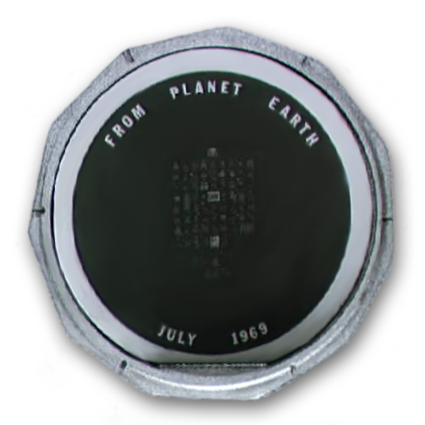
The disc was a late-breaking idea. It was only in June 1969 that the US State Department authorised NASA to solicit messages of goodwill from world leaders to be flown and left on the Moon. In those days before fax, email and Internet, this triggered a minor diplomatic frenzy. Hurried invitations went out from Thomas O Paine, the NASA Administrator who was ultimately responsible for the lunar missions.
In all, 116 countries were contacted through their embassies in Washington DC, but only 72 responded in time (The United Nations had 127 member states by that time.) With the initiator US, it made up 73 nations. The disc carried statements by US presidents Eisenhower, Kennedy, Johnson and Nixon, each of who had provided political leadership to the American space programme.
Some countries were confused by NASA’s unusual request. Others asked for more details — without realizing that the window for their inclusion was closing fast. Sri Lanka, then Ceylon, was among those countries that did respond. But for unknown and unexplained reasons, Prime Minister Dudley Senanayake declined to send a message to the Moon.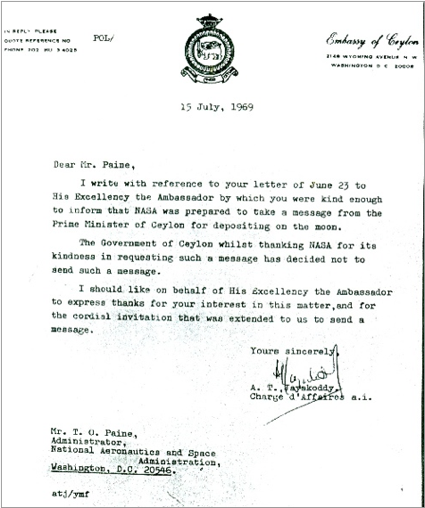
In a letter dated 15 July 1969 addressed to the NASA Administrator, A T Jayakoddy, Charge d’Affairs at the Embassy of Ceylon in Washington, wrote:
“The Government of Ceylon whilst thanking NASA for its kindness in requesting such a message has decided not to send such a message.”
The reply, cushioned in diplomatic niceties, gives no hint or reason for the decision. Ceylon thus ruled itself out from being part of the historic mission to the Moon.
Was it some misplaced geopolitical considerations, or simple diplomatic arrogance that led to Ceylon’s negative decision? Why did the Cambridge-educated, liberally inclined Prime Minister turn down the historic opportunity? After all these years, we might never know.
The Ceylonese government’s letter of decline is now part of the public record, thanks to a book that came out in 2007. Titled “We Came In Peace For All Mankind: The Untold Story Of The Apollo 11 Silicon Disc”, it was researched and authored by Tahir Rahman, a Kansas-based physician and space historian.
Last minute rush
The book documents the full story behind this little known facet of the very widely covered Apollo 11 mission. It also reproduces each of the 73 goodwill messages, as well as those which were received too late for inclusion on the disc.
“I was amazed at how NASA and the State Department rushed to get these messages before launch,” says Rahman. He took two months to locate from the Library of Congress the boxes in which Administrator Paine had preserved the full correspondence.
When I contacted him recently for additional insights, Rahman replied: “I do not have any information about why Sri Lanka did not send an Apollo 11 goodwill message.”
Sir Arthur C Clarke, with whom I worked for over 20 years, was also intrigued by Ceylon’s decision, which he didn’t know about until Rahman’s book reprinted the official letter. His only remark: “Mysterious are the ways governments think and work.”
The Apollo Program, initiated by President John F Kennedy in 1961, was mandated to land a man on the moon before that decade ended. It was one of the largest and most expensive technological undertakings in history, which eventually saw 12 American astronauts walk on the Moon in six successful missions between 1969 and 1972. (One mission, Apollo 13, was aborted due to an accident but the astronauts returned to Earth.)
The engineering and biomedical preparations for the first Moon landing had been meticulously planned for years. Yet the silicon disc idea had to move from idea to launch in just about a month. That didn’t allow much notice for world leaders to respond.
But the few dozen who did congratulated the United States and its astronauts for making history, and expressed hope for peace to all nations of the world. Some handwrote their messages while others typed. Many were in local languages. A few included intricate artwork, such as the Vatican’s message by Pope Paul VI.
Among those who sent messages were a number of Asian countries including Japan, Malaysia, the Philippines and Korea. Ceylon’s South Asian neighbours Afghanistan, India, Maldives and Pakistan also joined.
“I fervently hope that this event will usher in an era of peaceful endeavor for all mankind” wrote Indira Gandhi, Prime Minister of India.
M Yahya Khan, President of Pakistan, said: “Greetings and felicitations from Pakistan to the American Astronauts who blazed a new trail for mankind by landing on the Moon.”
The Cold War politics are evident in how governments responded, or chose not to. For example, China’s message came from Chiang Kai-Shek, President of Taiwan –- the only Chinese government recognised by the US at the time. Similarly, the Vietnamese message was issued by the president of South Vietnam, whose regime fell in 1975. The Soviet Union and most of the eastern bloc countries were notably absent. However, Nicolae Ceauşescu of Romania sent a one-liner.
Many members of the then fledgling Non-Aligned Movement (NAM) also took part. Josip Broz Tito, President of Yugoslavia and a founder of NAM, sent an enthusiastic message.
Some countries were initially cautious or uncertain. King Bhumibol Adulyadej of Thailand said in a telegram: “In view of our total ignorance of this project, would appreciate any information you can provide concerning NASA’s invitation to send message… number of countries responding… methods of recording and method of deposit on the Moon.” In the end, the Thai government sent a message just in time.
The king of Thailand is only one of two heads of state still holding office; the other is Queen Elizabeth II. Reading the messages, whose English translations are available online, is like entering a time capsule. Some countries have since changed names. Others have been subsumed by neighbours, or broken into two or more independent states. Geopolitical map of the world has been completely redrawn.
Almost forgotten
Even as the invitations went out, NASA was still trying to figure out how best to archive the messages to withstand harsh conditions on the Moon. Miniaturisation was essential as weight was at a high premium on the spacecraft.
One of NASA’s regular suppliers, the Sprague Electric Company of North Adams, Massachusetts, devised a new technique to inscribe the microscopic messages on the 1.5 inch, 99%-pure silicon disc. Silicon was chosen because it can withstand the extreme temperatures on the Moon.
The same technology is now widely used to make integrated circuits in modern electronics including computers. New at the time, it enabled each letter to be reduced 200 times to a size much smaller than the head of a pin.
The letters, no larger than one-fourth the width of a human hair, could be read under a microscope without any other playback facility. The only text readable by the naked eye is the wording on the rim: “From Planet Earth” and “July 1969″.
Sprague successfully delivered it one week prior to departure, but NASA then wanted to include late arriving messages. The final disc was ready only five days before Apollo 11 lifted off.
Having carried it to the Moon, the astronauts almost forgot to leave the disc behind. In his book, Rahman describes what happened.
Armstrong and Aldrin had only two and a half hours in which to explore the landing site, collect moon rocks and set up some scientific instruments. They also had to take part in some commemorative activities, including erecting the American flag and reading the inscription from the plaque. When President Nixon made an unscheduled call, it further crowded their schedule.
They were about to leave the Moon when Armstrong suddenly remembered the little “package” that was taped on to the arm of his colleague’s spacesuit. Aldrin, already up on the ladder, tossed it down to the ground. Armstrong nudged it with his foot –- there was no time for photographing or filming the moment. They had bigger things to worry about: if the lunar module failed to take off, they would be marooned on the Moon.
“The [transcript] shows that the astronauts almost forgot to leave it on the Moon. Buzz Aldrin confirmed that when I interviewed him,” says Rahman. “The mission was designed for safety first, so I can’t say more attention should have been paid to it. I am just glad it got there!”
After the astronauts returned safely to the Earth to a heroes’ welcome, the silicon disc was quickly forgotten. It earned only an occasional footnote in detailed histories of the Apollo missions. With his detailed account, Rahman has finally filled in the missing story.
Rahman feels that the messages are even more relevant today than they were when hurriedly written 40 summers ago. “The Apollo 11 plaque which states ‘We Came in Peace for all Mankind’ is one of the most important documents in world history — so are those goodwill messages.”The picture in the attachment was taken on the Final Days at the battlefield in Mullaitivu, Northern Province of SRI LANKA when the so called "Invincible " terrorists named as LTTE or Liberation Tigers of Tamil Eelam, were completely decimated by the Sri Lanka Armed services. The long drawn out war of 30 years is over and PEACE has dawned in Sri Lanka once again.
The picture epitomises the gruesome atmosphere of a fierce battle, and the natural humanitarian action of a Sri Lanka Army soldier saving a Tamil toddler and taking him to safety.The toddler shows full confidence in the soldier. This picture can be compared to the award winning picture of the small girl crying and running naked when a napalm bomb was exploded by US Army against civilians in Vietnam , which was splashed all over the cover of TIME magazine and in all world newspapers.


